 Residential
 Home Theater
 Home Gym
Left-handed and right-handed golfers hit their clubface and follow-through toward opposite sides of a simulator room, so wall panel systems for golf simulators need mirrored acoustic layouts and impact protection zones. A panel plan built for a right-handed swing leaves the wrong wall exposed to ball strikes and shock waves when a left-handed golfer uses the same space.
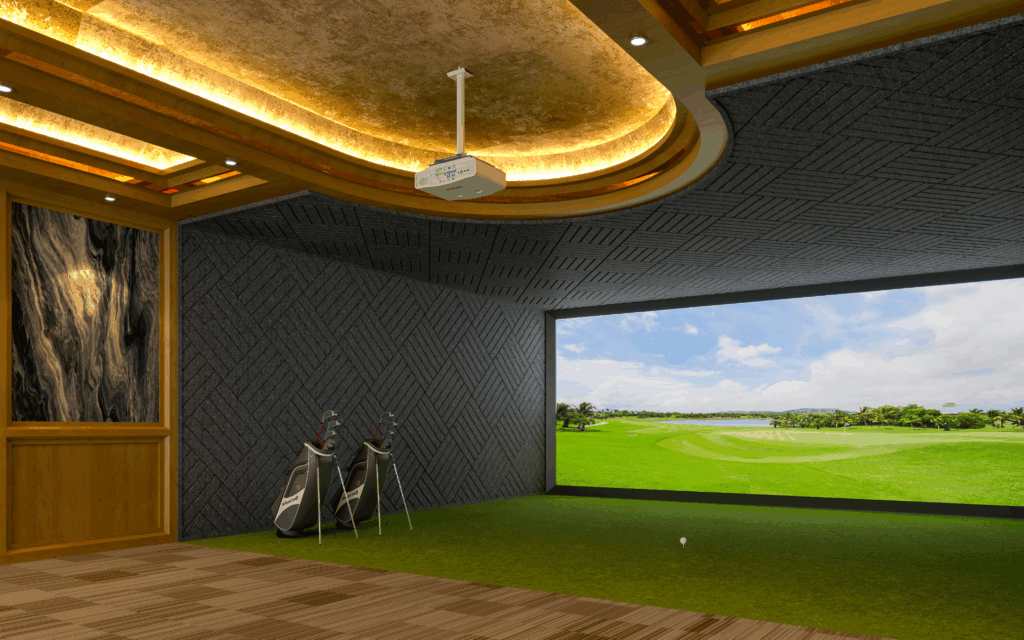
Picture a contractor finishing out a garage bay for a client who just bought a launch monitor and screen setup. He installs the same acoustic panel layout he used last month for a neighbor down the street — foam in the corners, a few panels behind the hitting area, done. Three weeks later, the homeowner calls back. He’s left-handed. His follow-through swings toward the wall the contractor left bare, and a mishit already dinged the drywall behind the impact screen. The panel layout wasn’t wrong. It was just built for the wrong-handed golfer.
This happens more often than people expect, especially with contractors who build a few simulator rooms a year rather than dozens. The room dimensions, the screen, the launch monitor placement — all of that stays roughly the same regardless of handedness. But the acoustic and impact-protection needs shift to the opposite wall entirely, and that’s the detail that gets missed.
Key Takeaways
- Right-handed golfers generate the highest impact and shock noise on the left wall of the hitting bay; left-handed golfers generate it on the right wall.
- A standard simulator room runs 10 to 15 feet wide and 15 to 20 feet deep — leaving little margin for a mismatched layout.
- Most acoustic panel installs for golf simulators use 2-inch to 4-inch thick panels rated for mid-to-high frequency absorption, since club and ball impact noise sits in that range.
- Panels placed on the wrong side won’t fail structurally, but they leave the actual strike zone under-protected and the echo problem unsolved.
- Swapping panel placement for handedness typically adds no extra material cost — it’s a planning decision, not a budget one.
Where Does the Ball Actually Travel in a Left-Handed vs. Right-Handed Setup?
A right-handed golfer stands with the target line running left, and the clubhead moves through impact traveling from right to left across the body. That means the harshest sound and the highest risk of a mishit heading off-target lands on the left-hand wall of the bay, relative to someone standing at the tee mat facing the screen. A left-handed golfer mirrors that completely — the swing path runs the opposite direction, and the wall most exposed to impact noise and stray ball flight is on the right.
This isn’t just about where a slice or hook might send a ball. It’s about where the acoustic energy from club-to-ball contact, the follow-through, and any incidental contact with a side wall actually concentrates. In our experience, most drywall damage in simulator rooms doesn’t come from screen strikes — it comes from a follow-through catching a side wall that wasn’t padded because the layout was copied from a different setup without checking which hand the golfer plays.
Why Doesn’t a Symmetrical Panel Layout Just Solve the Problem?
Some contractors try to sidestep the whole issue by paneling both side walls evenly, figuring it covers either scenario. That works for pure sound absorption — evenly distributed panels do cut echo and reverb regardless of which wall takes more direct impact. But it doubles material needs in a garage or basement conversion where budget and wall space are already tight, and it still doesn’t address impact-specific protection. Impact zones need something a general absorption panel isn’t necessarily built for: enough density and mounting rigidity to take a direct clubhead or ball strike without deforming or losing adhesion over time. A panel chosen purely for its Noise Reduction Coefficient, a standard measurement defined by acoustic testing standards, isn’t automatically rated for that kind of repeated physical contact. So the practical answer is a mirrored layout: heavier-duty panels concentrated on the strike-side wall based on handedness, standard absorption panels elsewhere.
How Should Contractors Plan Panel Placement Before Installation?
The fix is straightforward once it’s on the radar. Before ordering or cutting any golf simulator panels, confirm handedness first — not screen size, not enclosure brand, not launch monitor model. That single detail determines which wall gets the reinforced treatment. A practical planning sequence looks like this:
- Ask the golfer which hand they play, not which hand they write with. These don’t always match, and guessing wrong flips the entire layout.
- Map the swing arc. Stand at the tee mat position and trace where the clubhead travels through impact and follow-through — that arc points to the wall needing the densest panel coverage.
- Concentrate impact-rated panels on that wall, typically extending 6 to 8 feet from the hitting mat toward the screen, since that’s where follow-through contact is most likely.
- Treat the remaining walls and ceiling for general echo control, since ball flight noise and simulator audio bounce off every surface, not just the strike-side wall.
- Leave the non-strike wall lighter on reinforcement but not untreated — some absorption is still needed to manage overall room reverb.
For rooms hosting both a right-handed and left-handed golfer — a common setup for households or shared training spaces — the safer approach is reinforcing both side walls to the higher standard rather than picking one. It costs more up front but avoids a mid-project retrofit when the second golfer starts using the bay.
What Happens When a Multi-Use Room Complicates the Layout?
Golf simulator rooms rarely stay single-purpose for long. A contractor might build out a garage bay that later doubles as a home gym or gets paired with a media setup borrowing design cues from home theater acoustic treatment. When that happens, the handedness-specific panel zone still needs to stay intact — it shouldn’t get sacrificed for shelving, mirrors, or equipment racks added later. What we see most often is homeowners adding gym equipment along the “safe” wall after the simulator is installed, not realizing that wall was left lighter on protection because it wasn’t the strike zone — not because it was available storage space. Flagging this during the original acoustic consultation saves a second visit and a second invoice down the line.
According to guidance from the Occupational Safety and Health Administration on workspace impact hazards, reinforced barriers in areas with repeated physical contact reduce both material damage and injury risk — a principle that applies just as directly to a home simulator bay as it does to a commercial setting.
Frequently Asked Questions
Does a switch-hitting golfer need panels on both walls?
Yes. If more than one golfer uses the bay, or one golfer practices both orientations, both side walls should get impact-rated treatment rather than the lighter absorption panels typically used on the non-strike wall. It costs more upfront but avoids retrofitting the room later.
Why does the swing arc matter more than the room’s overall square footage?
Room size affects how much material is needed overall, but the swing arc determines where the highest-impact panels need to go. A contractor can build the same 12-by-18-foot room for two golfers and still need a completely mirrored panel layout depending on which hand each one plays.
Can standard drywall handle the strike-side wall if it’s just for occasional use?
No. Even occasional follow-through contact concentrates enough force to dent or crack standard drywall over repeated sessions. Impact-rated panels in the 2-inch to 4-inch range are built to absorb that contact without deforming, which unfinished drywall isn’t designed to do.
Does panel placement affect launch monitor accuracy?
Indirectly, yes. Panels that reduce excess reverb also cut down on sound interference that some radar and camera-based launch monitors can pick up as background noise. Poorly placed or missing panels won’t break the monitor, but they can add inconsistency to shot readings in an enclosed space.
How far should impact panels extend from the hitting mat?
A common range is 6 to 8 feet from the tee mat toward the screen, covering the zone where the clubhead travels through impact and follow-through. Rooms with a shorter distance between the mat and side wall may need that coverage extended closer to the full wall length.
What if the contractor doesn’t know the golfer’s handedness before ordering panels?
It’s worth pausing the order until that’s confirmed, since flipping the layout after installation means removing and remounting panels rather than just adding more. A five-minute conversation with the homeowner upfront prevents a return trip and wasted material.
Thinking About This For Your Own Simulator Room?
If you’re planning a golf simulator build and want to talk through panel placement based on handedness, room size, or shared use, it helps to walk through the layout before anything gets mounted.
Send a room diagram with measurements to jeff@residentialsoundpanels.com and we’ll customize the layout based on your room dimensions and simulator configuration.
Design Your Golf Simulator Panel System
Want Help Designing a Quiet Simulator Room?
A great golf simulator isn’t just about the screen or speakers. The room itself plays a big role in how everything sounds. If audio feels off—echo, unclear dialogue, uneven volume—acoustic wall panels can fix it.
At Residential Sound Panels, we design solutions that improve sound clarity and control without overcomplicating your setup. With years of experience, we help turn ordinary rooms into spaces that sound clean and balanced.
Want to improve your golf simulator room? Reach out today to get started.
Use our contact form or call our team at (801) 619-7044 to learn more.
Design Your Golf Simulator Panel System
References
- Occupational Safety and Health Administration. Guidance on Workplace Impact and Barrier Protection. U.S. Department of Labor. 2024.
- Acoustical Society of America. Noise Reduction Coefficient Testing Standards. ASA Publications. 2023.
- National Institute of Standards and Technology. Sound Absorption Measurement Guidelines. NIST. 2022.
- American National Standards Institute. ANSI S1 Acoustics Standards Series. ANSI. 2023.
- Wikipedia contributors. Noise Reduction Coefficient. Wikipedia, The Free Encyclopedia. 2025.