 Residential
 Home Theater
 Home Gym
Acoustic panels and golf simulator impact panels solve two different problems: acoustic panels manage sound reflection and noise transfer, while impact panels are built to absorb repeated golf ball strikes at speeds that can exceed 150 mph without tearing, denting the wall behind them, or losing their surface integrity over time.
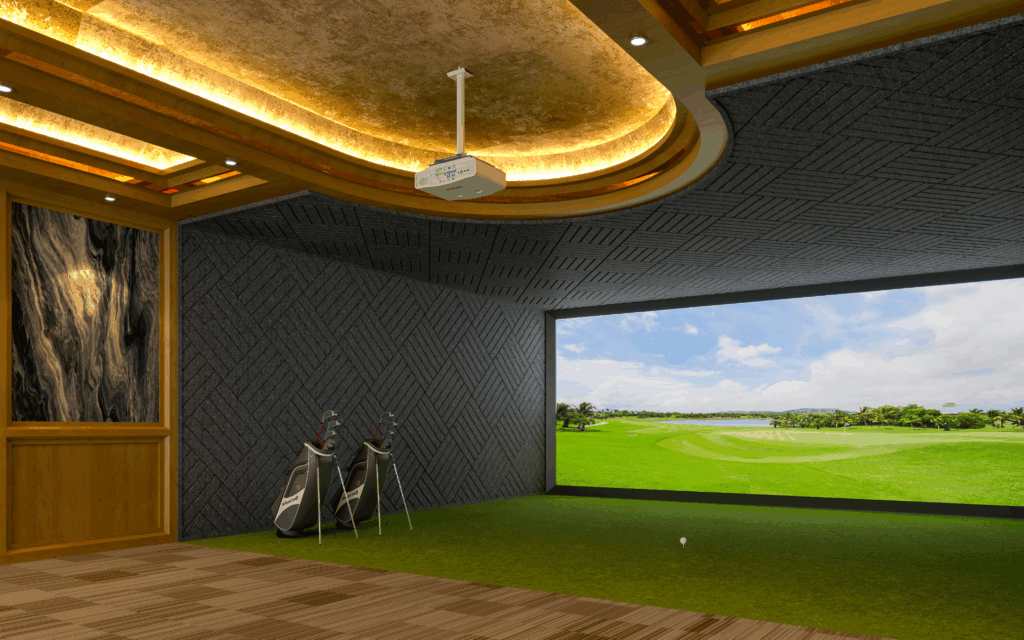
Homeowners building a simulator room often assume any thick foam panel will do the job. That assumption is the most common misconception in the industry, and it’s the one worth clearing up before anyone spends money on the wrong material. A panel rated for a home theater or office is not built to take a direct hit from a golf ball. It’s built to control echo and soften sound waves bouncing around a room. Those are two different engineering problems, and mixing them up leads to torn panels, damaged drywall, and repeat purchases within months.
Contractors installing simulator rooms run into this constantly. A client sees a “sound panel” online, likes the price, and asks for it to be installed behind the screen and impact zone. Six weeks later, there’s a hole in the wall where a mishit driver shot went straight through foam that was never designed for ballistic contact. The panel absorbed sound fine. It just wasn’t built to absorb a 0.45-ounce ball traveling at swing speed.
Key Takeaways
- Golf ball swing speeds regularly exceed 100-150 mph off the driver, generating repeated blunt-force contact that standard acoustic foam is not rated to absorb
- Impact panels typically use denser, layered materials designed to stop and dissipate kinetic energy, not just soften sound reflections
- Home theater and office acoustic panels are rated for sound absorption coefficients (NRC ratings), not impact resistance — the two specs are unrelated
- Installing standard acoustic foam in a golf simulator impact zone often results in tearing or wall damage within the first few months of regular use
- A properly built simulator room usually needs both product types: golf simulator panels in the strike zone and standard acoustic treatment on side and rear walls for noise control
What Acoustic Panels Are Actually Built to Do
Acoustic panels manage sound. They’re made from materials like compressed fiberglass, mineral wool, or acoustic foam, and their job is to reduce echo, control reverberation, and stop sound from leaking into other rooms or outside the house. The performance metric that matters here is the Noise Reduction Coefficient, or NRC, which measures how much sound a material absorbs versus reflects. According to the National Institute of Standards and Technology, acoustic materials are tested under controlled lab conditions specifically for sound absorption, not structural durability.
That distinction matters. A panel can have an excellent NRC rating and still fall apart the first time something solid hits it. Home theater rooms and home gyms don’t need impact resistance because nothing is striking the walls directly. Home theater sound panels are chosen for clarity and echo control, and home gym panels are chosen to dampen the noise of dropped weights and equipment vibration. Neither application involves a small, dense object traveling at high velocity toward the wall.
Why Golf Simulator Rooms Need a Different Category of Panel
A golf simulator room is a different animal entirely. The screen and the wall behind it take direct, repeated hits from real golf balls during every session. In practice, what happens is the ball strikes the impact screen first, but energy still transfers through to whatever is behind it — and over hundreds of swings a month, that transferred force will find any weak point in cheap padding or standard foam.
This is why golf simulator impact panels are engineered differently. They typically combine a dense core material with a durable outer layer that can take repeated blunt-force contact without compressing permanently or splitting at the seams. Some setups also use rigid backing behind the panel itself, adding a second layer of protection between the ball and the framing or drywall. The goal isn’t just sound control anymore — it’s containment and protection, with sound dampening as a secondary benefit.
Contractors quoting these installs should treat the impact zone and the surrounding walls as two separate scopes of work. The wall directly behind the screen and the side walls within the likely ball path need impact-rated material. The ceiling and rear walls, where balls rarely reach, can often use standard acoustic treatment instead, which keeps material costs from ballooning unnecessarily.
Quick Comparison: Acoustic Panels vs Impact Panels
How Homeowners and Contractors Should Plan a Simulator Room
Start with a room diagram before ordering anything. Mark where the screen sits, where the golfer stands, and the realistic spread of a mishit shot — most builders plan for a cone extending outward from the hitting position, since even a well-struck ball can veer several feet off line. Everything inside that cone gets impact-rated material. Everything outside it can use standard acoustic panels chosen for noise control.
Ceiling height matters too. Rooms under roughly 9 feet often see more ceiling strikes on shorter irons and wedges, so ceiling protection becomes part of the impact zone rather than an afterthought. This is one detail generic online buying guides tend to skip entirely, because it depends on the specific room geometry rather than a one-size-fits-all rule.
Budget planning should account for this split too. Impact-rated material generally costs more per square foot than standard acoustic foam because of the reinforced core and outer layer, so pricing out an entire room at impact-panel rates when only the strike zone needs it leads to unnecessary overspending. A contractor who separates these zones on the quote gives the homeowner a more accurate number and avoids the awkward conversation later about why the budget ran over.
Common Mistakes When Choosing Between the Two
The most frequent error, as mentioned earlier, is using standard acoustic foam directly behind the impact screen because it’s cheaper and readily available. The second most common mistake runs the opposite direction: covering an entire home theater or gym in impact-rated panels when no ball or projectile is ever going to hit those walls. That adds cost without adding benefit, since impact panels aren’t necessarily better at sound absorption than purpose-built acoustic material — they’re built for a different job entirely.
Another mistake worth flagging: assuming impact panels eliminate the need for sound treatment altogether. They don’t. A simulator room with only impact protection and no acoustic treatment on the remaining walls will still echo, and neighbors or family members elsewhere in the house will still hear every swing. The two product types work together, not as substitutes for each other. Organizations like the Acoustical Society of America have published general research on how room shape and surface material affect sound behavior, and the same principles that apply to a home theater apply to the non-impact walls of a simulator room.
Frequently Asked Questions
Can regular acoustic foam handle occasional golf ball hits if the screen absorbs most of the impact?
Not reliably. Even a good impact screen transfers residual force to the wall behind it, and over dozens of sessions that repeated stress compresses or tears standard foam. Impact panels are built with denser cores specifically to absorb that transferred energy session after session.
Why do contractors sometimes recommend impact panels only on specific walls instead of the whole room?
Because only the area within the realistic shot-dispersion cone actually takes hits. Side walls, rear walls, and ceilings outside that path rarely see contact, so using standard acoustic panels there keeps material costs down without sacrificing protection where it matters.
Do golf simulator impact panels also reduce noise, or just protect the wall?
Most impact panels provide some sound dampening as a secondary benefit, but they’re not optimized for it the way dedicated acoustic panels are. Rooms that need both quiet performance and impact protection typically combine impact panels in the strike zone with standard acoustic treatment elsewhere.
Is ceiling protection necessary in a golf simulator room?
Yes, particularly in rooms under about 9 feet of ceiling height, where shorter clubs like wedges and short irons are more likely to strike upward. Skipping ceiling protection is one of the more overlooked gaps in simulator room planning.
How can a homeowner tell if a panel they’re considering is actually impact-rated?
Check the product description for language around impact resistance, layered core construction, or golf-specific use rather than just an NRC sound rating. A panel marketed purely on echo reduction or theater use, with no mention of ball impact, is almost certainly not built for a simulator strike zone.
Does a home gym or home theater ever need impact-rated panels?
Generally no, unless the room doubles as a golf hitting space. Standard acoustic panels are the right choice for gyms and theaters since the noise sources there are vibration and sound reflection, not projectile impact.
Ready to Get the Right Panels for Your Room?
Whether it’s a simulator build, a home theater upgrade, or a gym that needs quieting down, choosing the right panel type from the start saves money and rework. Choose your application type to get started, or call for a quote and get straight answers on what your specific room actually needs.
Send a room diagram with measurements to jeff@residentialsoundpanels.com and we’ll customize the layout based on your room dimensions and simulator configuration.
Design Your Golf Simulator Panel System
Want Help Designing a Quiet Simulator Room?
A great golf simulator isn’t just about the screen or speakers. The room itself plays a big role in how everything sounds. If audio feels off—echo, unclear dialogue, uneven volume—acoustic wall panels can fix it.
At Residential Sound Panels, we design solutions that improve sound clarity and control without overcomplicating your setup. With years of experience, we help turn ordinary rooms into spaces that sound clean and balanced.
Want to improve your golf simulator room? Reach out today to get started.
Use our contact form or call our team at (801) 619-7044 to learn more.
Design Your Golf Simulator Panel System
References
- National Institute of Standards and Technology. Acoustic Materials Testing Standards. NIST. 2025.
- Acoustical Society of America. Room Acoustics and Sound Absorption Fundamentals. ASA Publications. 2024.
- Wikipedia. Noise Reduction Coefficient. Wikimedia Foundation. 2025.
- Wikipedia. Golf Ball Speed and Swing Dynamics. Wikimedia Foundation. 2025.